TL;DR: Choose Your Own Hardware Adventure
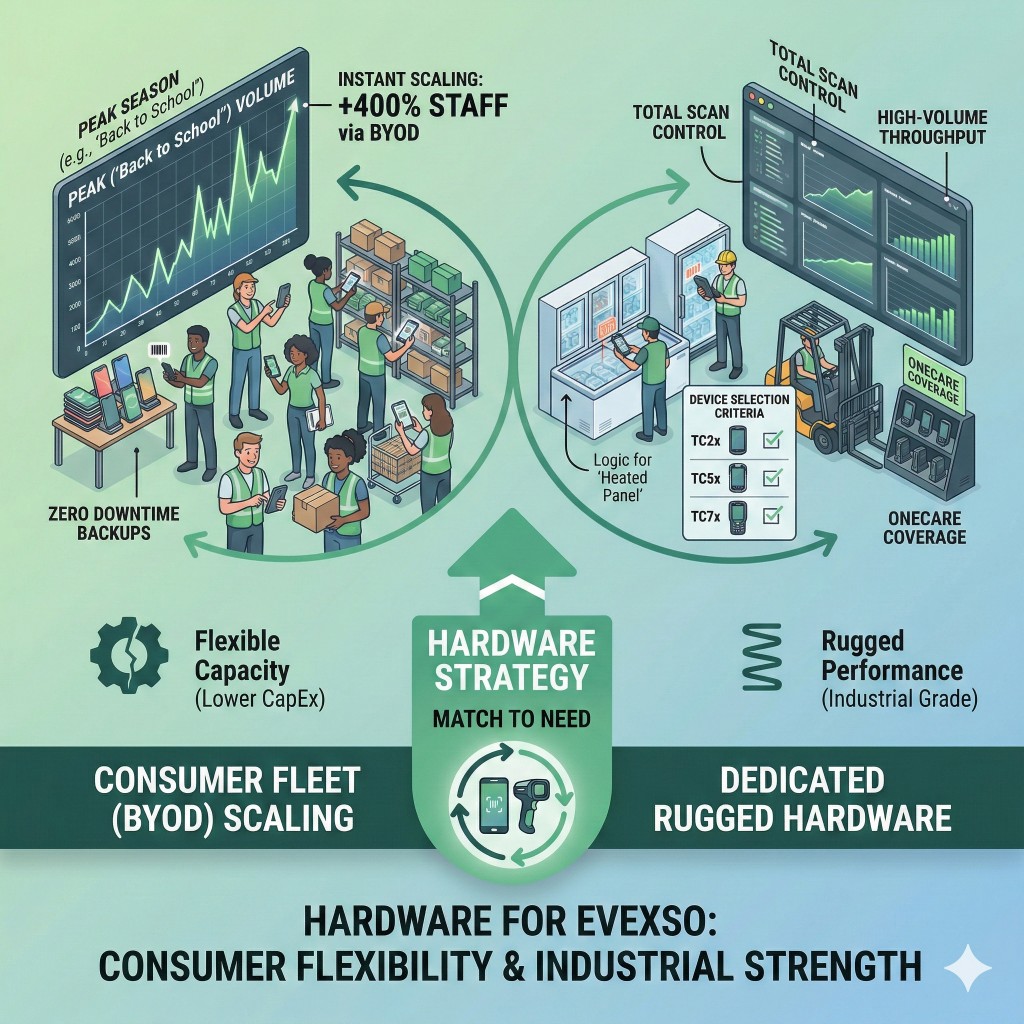
Hardware selection for a modern WMS isn't about picking the "best" device—it's about matching the device to the environment and operational model. eveXso's Hardware Sovereign approach means you choose the hardware strategy that fits your business, not the other way around. Whether it's leveraging existing consumer devices for peak-season flexibility or deploying ultra-rugged Zebra scanners for freezer operations, the choice is yours.
One of the most frequent questions we receive is: "What hardware do I need to run eveXso?" The answer reveals a fundamental shift in how modern warehouse systems should operate.
Unlike legacy WMS platforms that lock you into proprietary hardware ecosystems, eveXso is built on a Hardware Sovereign philosophy: you own the decision. Your choice of hardware should match your operational environment, budget constraints, and scaling strategy—not be dictated by your software vendor.
Two Paths to Success
When selecting hardware for eveXso, you have two primary strategies, each with distinct advantages:
Path 1: The Consumer Device Strategy (iOS/Android)
For many warehouses—especially those with seasonal demand spikes or rapid growth trajectories—the most cost-effective approach is leveraging consumer-grade smartphones and tablets.
The BYOD Advantage: Zero Hardware Debt
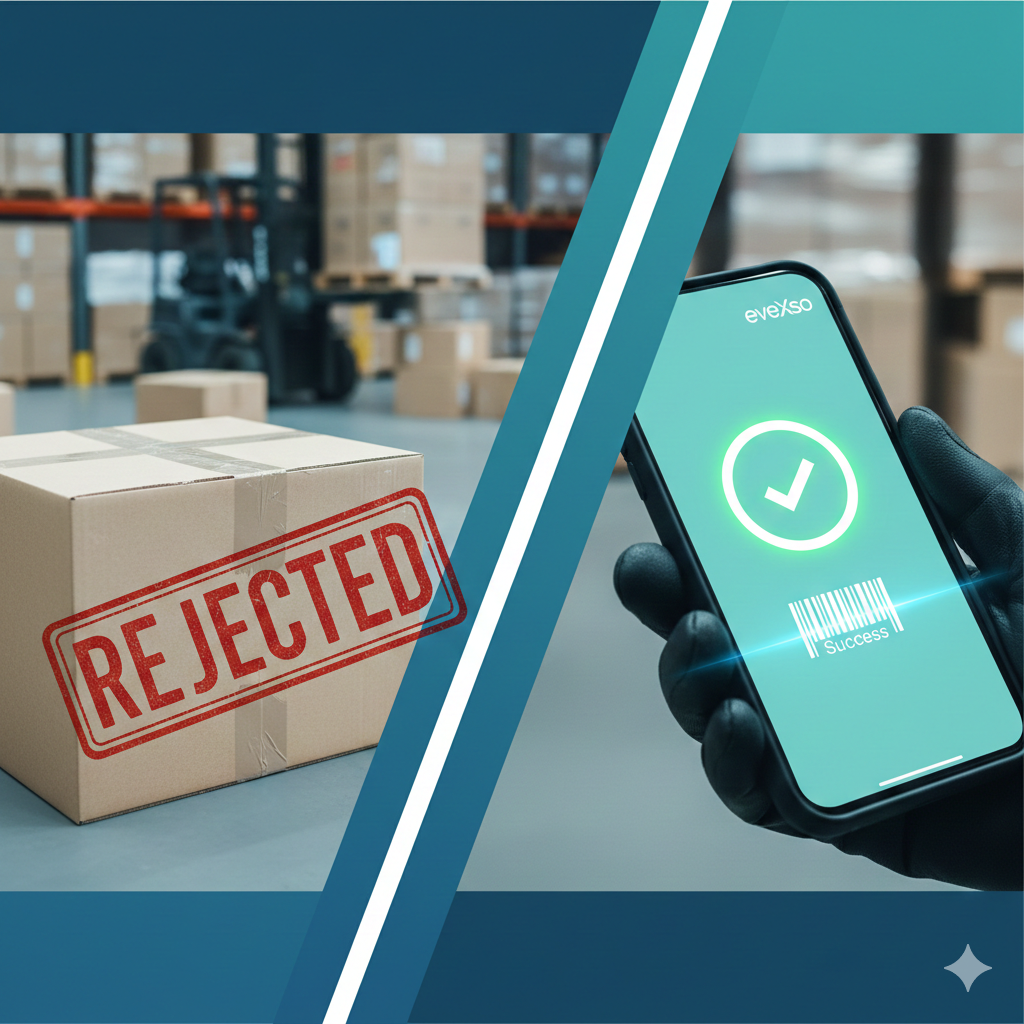
eveXso's mobile apps (iOS and Android) use the device's onboard camera as the primary scanning method. This unlocks a powerful operational strategy: Bring Your Own Device (BYOD).
Real-World Example: Back-to-School Surge
A Melbourne-based education supplier operates with a core team of 15 full-time staff during the quiet months. But when the January "Back to School" rush hits, they scale to 60+ temporary pickers for 6 weeks.
The Traditional Cost: Purchasing 45 ruggedized scanners at $2,000+ each = $90,000+ in CapEx that sits idle for 10 months of the year.
The eveXso Approach: Temporary staff use their own smartphones. The business saves $90,000+ and deploys workers instantly—no waiting for hardware procurement or complex staging.
The "No Downtime" Resilience
Another hidden benefit: device redundancy. If a scanner drops and the screen cracks, operations halt until IT can source a replacement. With BYOD:
✓ Instant Failover
A picker switches to their personal phone in under 60 seconds by logging into the app.
✓ Zero Procurement Delay
No need to wait for IT approval, hardware ordering, or device staging—operations continue uninterrupted.
When Consumer Devices Work Best
- •Seasonal Operations: Scale worker count rapidly without hardware procurement delays or capital investment.
- •Clean Environments: Retail distribution centers, e-commerce fulfillment, light manufacturing, or climate-controlled warehouses.
- •High-Growth Businesses: Companies adding new warehouses or rapidly expanding headcount where CapEx flexibility is critical.
- •Cost-Conscious Operations: Eliminating the $50,000–$200,000+ upfront hardware investment typical of traditional WMS implementations.
Path 2: The Zebra Technologies Strategy (Android Enterprise)
For high-intensity, industrial environments, purpose-built enterprise hardware provides tangible advantages that consumer devices cannot match.
The Dedicated Scan Engine Advantage
While smartphone cameras are fast, a dedicated laser or imager scan engine provides:
📸 Camera Scanning
- • Requires adequate lighting
- • Needs 2-3 seconds to focus
- • Can struggle with damaged labels
- • Battery drain from camera use
⚡ Dedicated Scan Engine
- • Works in low-light or dark environments
- • Instant scan (<0.5 seconds)
- • Reads damaged, dirty, or poorly printed codes
- • Optimized battery life for 12+ hour shifts
The Performance Difference: In a high-volume operation moving 10,000+ items per day, the scan-speed difference between a camera and a dedicated engine can translate to 30–60 minutes of saved labor per picker, per shift.
The Zebra Partner Network
eveXso maintains a partnership with Zebra Technologies, the global leader in enterprise mobile computing. This provides customers with:
Device Staging
Pre-configured devices arrive ready to scan. No IT configuration required.
Technical Advisory
Access to Zebra's device specialists for environment-specific recommendations.
OneCare Support
Enterprise-grade warranty with next-business-day replacement and 24/7 support.
Zebra Product Tier Breakdown
Zebra offers three primary product families for warehouse operations, each designed for progressively harsher environments:
| Model Family | Best For | Key Features | Drop Rating |
|---|---|---|---|
TC2x Series Entry-Level Rugged | • Retail stock rooms • Light distribution • E-commerce picking | • 4" touchscreen • SE2100 scan engine • 8-hour battery • Basic drop protection | 4 ft / 1.2m |
TC5x Series Warehouse Workhorse | • General warehousing • Manufacturing floors • Distribution centers | • 5" touchscreen • SE4770 advanced scan engine • 12+ hour battery • Enhanced ergonomics • Faster processor | 6 ft / 1.8m |
TC7x Series Ultra-Rugged | • Heavy industrial • Outdoor yard operations • Extreme environments | • 6" display • SE5500 extended-range scanner • 15+ hour battery • IP67 dust/water sealed • Military-grade durability | 8 ft / 2.4m |
💡 The Sweet Spot: For most general warehouse operations, the TC5x Series offers the best balance of durability, battery life, and ergonomics. It's the "Goldilocks" device—rugged enough for daily drops, but not over-engineered (and over-priced) for standard distribution environments.
Specialized Environments: Freezer & Cold Storage
Cold storage and freezer warehouses present unique challenges that standard devices—consumer or enterprise—simply cannot handle.
The Fogging Problem
When a picker moves from a -25°C freezer into a +20°C dispatch area, condensation forms instantly on touchscreens and scan windows. Standard devices become unusable for 5–10 minutes while they defog—multiplied across dozens of picks per shift, this represents significant lost productivity.
Solution: Zebra MC9400 Freezer Edition
The Zebra MC9400 is purpose-built for sub-zero operations and solves the fogging challenge with specialized hardware:
❄️Heated Exit Window
The scan engine includes a heated exit window that prevents condensation from forming on the glass, allowing instant scanning when moving between temperature zones.
🔋Freezer-Rated Batteries
Standard lithium batteries lose 50%+ capacity below 0°C. The MC9400 uses cold-rated batteries that maintain full performance at -30°C.
🧤Heated Touchscreen
Remains responsive even when operated with heavy thermal gloves, eliminating the need to remove gloves to interact with the interface.
💪Industrial Durability
IP67 sealing against ice buildup, 8 ft drop rating, and designed to withstand daily impacts from forklifts and pallet drops.
The ROI Calculation: For a freezer operation running two shifts, the MC9400's anti-fogging technology can save 60–90 minutes of "wait time" per device, per day. That productivity gain alone often justifies the higher hardware cost within 12–18 months.
When Zebra Devices Are Essential
- •Freezer & Cold Storage: Operations below 0°C where consumer devices fail.
- •Heavy Industrial: Steel fabrication, concrete manufacturing, or mining logistics with high drop/impact risk.
- •Outdoor Yard Operations: Direct sunlight (screen visibility), rain exposure, or extreme heat.
- •High-Throughput Distribution: Operations where scan speed directly impacts labor costs (10,000+ scans/day per device).
- •Compliance-Critical: Pharmaceutical or food operations where device failure could halt production and trigger regulatory issues.
Decision Framework: Choosing Your Path
Use this quick checklist to determine the right hardware strategy for your operation:
Choose Consumer (BYOD)
Climate-controlled warehouse (15–30°C)
Clean environment (retail, e-commerce, light manufacturing)
Seasonal workforce scaling required
Budget-conscious or high-growth startup
Rapid deployment timeline (<1 week)
Multiple warehouse locations opening quickly
Choose Zebra (Rugged)
Freezer or cold storage (<0°C)
Heavy industrial environment (drops, impacts, dust)
Outdoor yard operations (sun glare, rain, extreme heat)
High-throughput (10,000+ scans/day per device)
Permanent workforce with established device pool
Mission-critical operations (pharma, tier-1 retail)
💡 Pro Tip: Many operations adopt a hybrid approach—Zebra devices for permanent staff in harsh zones (freezer, receiving dock) and consumer BYOD for temporary staff in climate-controlled pick/pack zones. eveXso supports both simultaneously without additional licensing complexity.
The Hardware Sovereign Promise
Whether you choose the capital-light flexibility of consumer devices or the industrial resilience of Zebra's enterprise portfolio, eveXso ensures you're never locked into a single vendor's ecosystem.
No Vendor Lock-In
Switch between device strategies as your operation evolves without needing to change your WMS.
Operational Flexibility
Run consumer devices in the pick zone and Zebra scanners in the freezer—simultaneously in the same warehouse.
Capital Efficiency
Deploy exactly the level of hardware investment your environment demands—no more, no less.
The Bottom Line
Hardware selection is no longer a binary choice between "cheap and fragile" or "expensive and rugged." The modern approach is environment-matched deployment:
→ Use consumer devices where speed, cost, and scaling matter most.
→ Deploy Zebra rugged devices where environmental demands and throughput intensity require specialized hardware.
→ Adopt a hybrid strategy to optimize CapEx while maintaining operational resilience.
With eveXso's Hardware Sovereign philosophy, the decision is always yours. Your operational needs drive the hardware choice—not arbitrary software limitations.
Need Help Choosing the Right Hardware?
Our team has deployed eveXso across hundreds of warehouses—from tropical outdoor yards to -30°C freezers. We understand the real-world performance trade-offs and can help you design a hardware strategy that matches your environment and budget.
Want to discuss your specific requirements? Book a discovery call to speak with our team about BYOD deployment, Zebra device selection, or hybrid hardware strategies for multi-zone operations.
You can also reach our team directly at sales@evexso.com or ask Dave (our AI assistant) specific questions about hardware compatibility and recommendations.