TL;DR: The Quick Summary for Busy Managers
Most businesses don't set out to outgrow their WMS — it happens gradually, and the symptoms get blamed on staff, carriers, or forecasting instead of the software. If you recognise two or more of these five signs (sub-98% accuracy, no real-time visibility, growth bottlenecks, painful integrations, or workarounds baked into daily operations), the ongoing cost of standing still almost always exceeds the cost of change.
Most businesses don't set out to outgrow their warehouse management system. It happens gradually — a few more SKUs, a new distribution centre, an acquisition, or simply years of accumulated workarounds that nobody ever had time to fix. Then one day, the cracks become impossible to ignore.
The challenge is that the symptoms of an underperforming WMS can look like other problems. Inventory discrepancies get blamed on staff. Slow fulfilment gets blamed on carriers. High write-off rates get chalked up to poor demand forecasting. The real culprit — outdated or inadequate warehouse software — often goes unaddressed for far too long.
If any of the following signs feel familiar, it may be time to take a hard look at whether your current system is still fit for purpose.
Your inventory accuracy is consistently below 98%
The industry benchmark for a well-run warehouse is 99% inventory accuracy or higher. If you're regularly sitting below that — or worse, you don't actually know your current accuracy rate — that's a significant problem.
Poor inventory accuracy is expensive in ways that aren't always immediately visible. Every discrepancy means staff time spent investigating and reconciling. Every stockout means a lost sale or an emergency replenishment order at a premium. Every overstock ties up working capital and warehouse space. And in industries like food and beverage or pharmaceuticals, inaccurate inventory can create serious compliance and traceability risks.
A modern WMS eliminates the root causes of inventory inaccuracy — manual data entry, paper-based processes, and stock movements that aren't captured in real time. If your current system can't deliver 99%+ accuracy, it's time to ask why.
Common symptoms
- Frequent stocktake discrepancies that take days to resolve
- Regular stockouts despite stock appearing available in the system
- High volume of customer complaints about incorrect or missing items
- Staff spending hours each week on manual stock counts and reconciliation
You don't have real-time visibility across your operation
If your warehouse managers are making decisions based on last night's data export, or if you need to physically walk the floor to know what's in stock, your visibility is already a competitive disadvantage.
Real-time inventory visibility isn't just a nice-to-have — it's the foundation for almost every other operational decision. Replenishment, labour planning, order prioritisation, and customer service all depend on knowing exactly what you have, where it is, and how it's moving. Without that, you're flying blind.
This becomes especially critical as businesses scale. A single site with a small team can get away with a lot through informal communication and institutional knowledge. Add a second warehouse, a new channel, or double your SKU count, and the cracks in your visibility rapidly become chasms.
Common symptoms
- No live dashboard showing stock levels and warehouse activity
- Inability to answer basic stock queries without running a report
- Different systems showing different stock figures with no clear source of truth
- Managers relying on gut feel and experience rather than data
“The real cost of a poor WMS isn't the software subscription — it's the invisible tax on every operation your warehouse runs every single day.”
Your system can't keep up with your growth
Many businesses implement a WMS when they're smaller, and it works well — until it doesn't. Order volumes increase. New product lines get added. A new site opens. An acquisition brings a different system into the mix. What was once adequate becomes a bottleneck.
The signs are often subtle at first: processes that used to take 10 minutes now take 30. The system slows down at peak periods. Workarounds — extra spreadsheets, manual steps, offline trackers — start accumulating as staff find ways around the system's limitations. Over time, these workarounds become embedded in daily operations, making the underlying problem harder to see and harder to fix.
A scalable WMS should grow with your business, not constrain it. If you find yourself regularly hitting the ceiling of what your current system can handle, that ceiling is costing you money.
Common symptoms
- System performance degrades noticeably during peak periods
- Adding new sites or channels requires significant custom development
- Staff maintaining parallel spreadsheets to fill gaps in the system
- Onboarding new product lines is slow and manual
Integration with your other systems is painful or non-existent
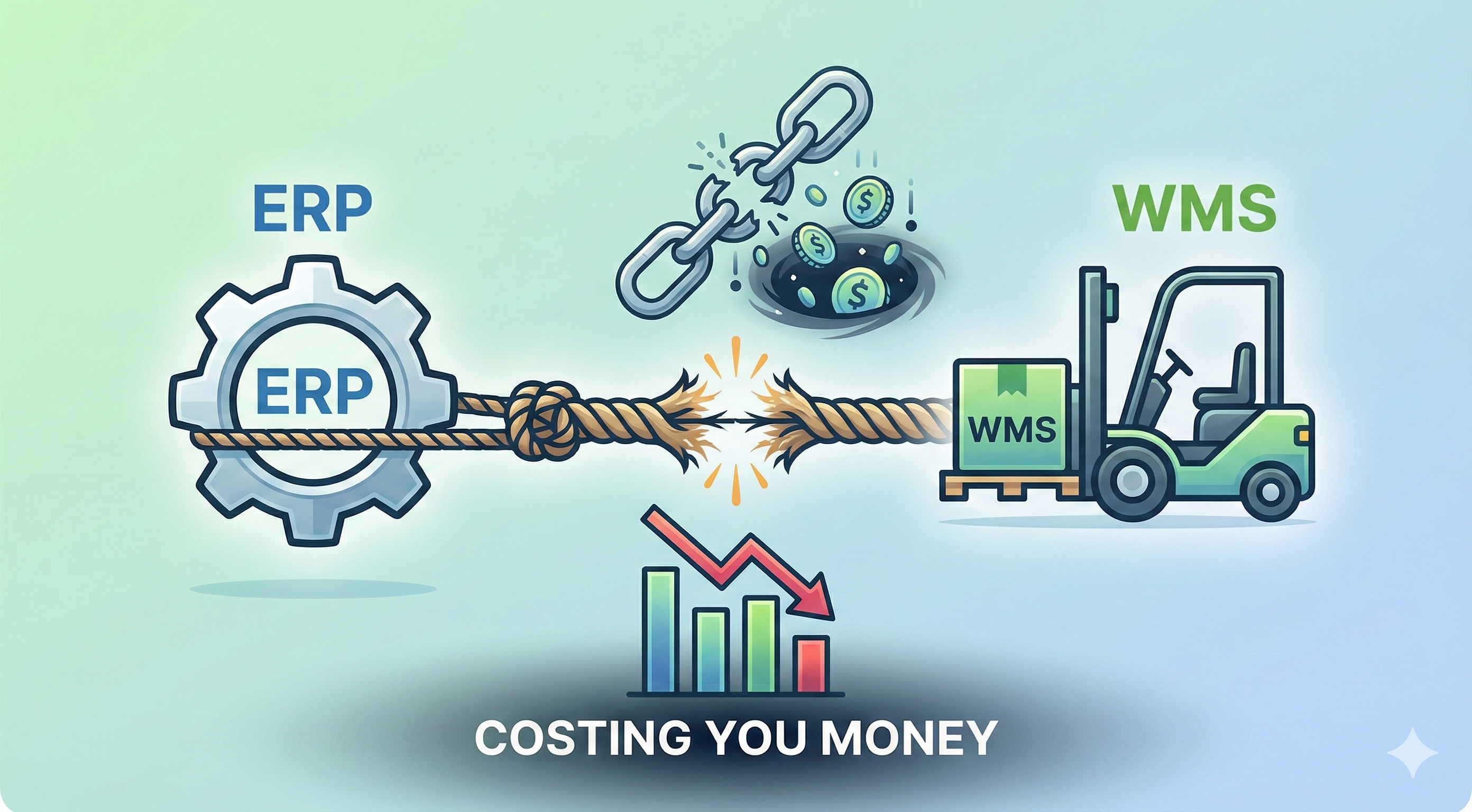
Your WMS doesn't operate in isolation. It needs to talk to your ERP for financial and procurement data, your transport management system for dispatch, your e-commerce platform for orders, and potentially your manufacturing systems for production planning. If those integrations are fragile, manual, or simply don't exist, you're creating unnecessary risk and inefficiency at every handover point.
Poor integration typically shows up as double data entry — staff keying the same information into multiple systems. It creates delays, because data only flows between systems in periodic batches rather than in real time. And it creates errors, because manual re-keying introduces mistakes that can ripple across your entire operation.
Modern WMS platforms are built with integration in mind, using standard APIs and pre-built connectors to common ERP and logistics platforms. If your current WMS treats integration as an afterthought, the ongoing cost of that gap is worth calculating carefully.
Common symptoms
- Staff manually re-entering data between systems daily
- Order status in the WMS doesn't match what the ERP or e-commerce platform shows
- Integration projects are consistently expensive, slow, and fragile
- Adding a new system to your tech stack feels daunting because of integration complexity
Your team has built the operation around the software's limitations
This is perhaps the most insidious sign of all, because it's the hardest to see. When a WMS has limitations, people adapt. They find workarounds. They build habits around the system's constraints. Over time, those constraints become invisible — they're just “how things are done here.”
But the cost is real. Every workaround is labour that doesn't need to exist. Every manual step is a potential error. Every process built around a system limitation is a process that's less efficient than it should be. And when it comes time to onboard new staff, those workarounds are hard to document, hard to teach, and easy to get wrong.
If your longest-serving warehouse staff are the only ones who truly understand how the system works — not because the operation is complex, but because the software requires tribal knowledge to navigate — that's a sign the software is working against you, not for you.
Common symptoms
- New staff take a long time to reach competency because of system complexity
- Only certain team members know how to run key reports or processes
- Multiple unofficial “cheat sheets” or guides exist to help staff navigate the system
- The answer to “why do we do it this way?” is often “because the system can't do it any other way”
What to do next
Recognising that your current WMS is holding you back is the first step. The second is understanding what a modern system should actually look like — and whether the investment in change is justified by the operational and financial return.
The short answer, for most medium-to-large operations experiencing two or more of the signs above, is yes. The ongoing cost of an underperforming WMS — in labour, errors, write-offs, and lost throughput — almost always exceeds the cost of change within 12–18 months of a new system going live.
The right approach is to start with a clear-eyed assessment of your current operation: where the pain points are, what they're costing you, and what a best-in-class operation at your scale and in your industry actually looks like. From there, you can build a business case that speaks the language of the CFO as much as the warehouse manager.
eveXso works with medium-to-large businesses across food and beverage, FMCG, retail, and manufacturing to replace underperforming WMS platforms with a system built for the complexity and scale of modern warehouse operations. If you'd like to understand what that could look like for your business, we're happy to start the conversation.
Curious whether you've outgrown your current WMS? Talk to Dave, our AI assistant, about inventory accuracy, real-time visibility, or system integration — or book a discovery call to walk through your operation with our team.